|
Click Here For Free Bodybuilding Newsletter
My
Story - The Early Years
Let me begin by sharing with you a couple my
before and after photo’s…
|
Before
|
After
|
 |
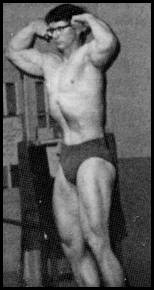 |
Here I am at age 16, 5’ 11”
& weighing a buck fifty-five.
|
Here I am weighing
212-pounds.
|
|
I wish I could tell you that the 57 Pounds of Muscle Gain displayed in
the “After
Photo” was accomplished in JUST 1 YEAR but the
TRUTH is it took me 12 long years and I was under the
guidance of some of the world’s most advanced,
and respected, bodybuilding coaches. My muscle gain
factor averaged only about 5 pounds a year! Suffice
it to say I wasn’t exactly a genetic superior as a bodybuilder.
It has been said that all men
are created equal! Do
I believe that? Does a chicken have lips? I know
I wasn’t created equal because from that day I was born
until my 16th year I was weak, skinny and
timid. I struggled mightily just to be on par physically
with other males my own age but to no avail. Basically
I was a bone rack with buggy whip arms, a chicken chest,
Venetian blind ribs, legs that looked like a pair of
pliers in boxer shorts and shoulders so narrow they almost
choked my neck (which looked like a pencil balancing
a medicine ball “my head”).
I know one thing. I was always the guy everybody put in a corner and
then picked dead last, first time every time, when it came
to games and team sport. It’s no wonder with things like
this happening to me that I’d start thinking if I was the
only person in a contest I’d still only place 2nd.
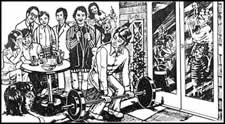 Not only was I underweight and weak but in addition to that I wore enormously
thick ‘Coke bottle bottom glasses’ and had the worse
case scenario of acne imaginable. To put it bluntly,
I was an unfortunate kid while growing up that the other
kids gravitated to when they wanted to ‘pound someone
to a pulp’. And ‘do me ugly’ they did. It wasn’t uncommon
to get the living dog crap out of me on a weekly basis IF I
could be caught. I say IF because I was a super
fast runner but if I got cornered I was basically screwed. Not only was I underweight and weak but in addition to that I wore enormously
thick ‘Coke bottle bottom glasses’ and had the worse
case scenario of acne imaginable. To put it bluntly,
I was an unfortunate kid while growing up that the other
kids gravitated to when they wanted to ‘pound someone
to a pulp’. And ‘do me ugly’ they did. It wasn’t uncommon
to get the living dog crap out of me on a weekly basis IF I
could be caught. I say IF because I was a super
fast runner but if I got cornered I was basically screwed.
I remember another time as a freshman in high school and some really BRUTALLY
HUGE guys in the senior class cornered me and were going
to haze me. I broke into tears and sobbed uncontrollably
and they shoved me, sneered with distain and said “Let
the baby go.” That was a close one. Whew!
Suffice it to say I sometimes felt as worthless as ‘tits on a Boar Hog’ most
of my childhood and teen years.
People used to call me “WEAKLING WEIS” and as a result of this I became very insecure regarding
my physical stature. I guess in one sense I was the
Classical weakling because I remember when I was a freshman
in high school and I tried pressing 80 pounds overhead
one day during PE. I lost control of this monster
|
poundage and fell over backwards with it putting a huge dent in the gym
floor and even a more gigantic dent in my fragile self
worth as a person. Why?
Because not only the guys but some of the most popular girls in school
saw this incident (some laughed and some sneered) and
I was embarrassed beyond belief. It was incidents like
this that kept my self esteem at low ebb socially and
as a result I didn’t even attempt to start dating women
until I was 21 years of age.
Oh yeah, I did eventually manage to finally press the 80 pound barbell
overhead while in PE class, and without falling backwards
but the only problem was when I was lowering the weight
down from my shoulders. I had my thumbs sticking straight
out from the bar (reminiscent of the ‘thumbs down
signal’) rather than wrapped around the bar. Well
as a result I ended up ripping the pockets out of my
shirt when my thumbs got hooked in them.
Or how about the time, one Monday morning, when I walked into the men’s
restroom at the high school and promptly got thrown out
through the door and landed on my back up against the
wall in the hall way. The next thing I see is this HUGE
(he reminded me of the ex WWE Pro Wrestler Brock Lesnar)
senior classman with his size 13 shoe on my throat. He
looked like Mr. Tomato Head as he screamed obscenities
in my face. I was so scared I almost pooped my self. No
joke! What brought on altercation?
Ah, well I had hit him in the ear with a very hard snow ball (if I’d had
stuck a rock in the snowball I’ll bet it would have hurt
even worse J) two days previous and then was laughing at him hysterically because
he couldn’t catch me as I ran away. This is probable
the only incident where I deserved to get beat up.
When I wasn’t getting the stew beat out of me I took a lot of guff in
the form of tainted name calling (besides “WEAKLING WEIS” I was called “DENNY DIMWIT”, “COKE BOTTLE
EYES” “MR. MAGOO” “SISSY BOY” and a host of other, what I considered back
then, awful names) which gave me even more of an inferiority
complex. I felt like worm food back then.
I wanted so badly to be a Fitnessaurus (A creature craving physical perfection or put
another way; Any beast gratified by muscular development)
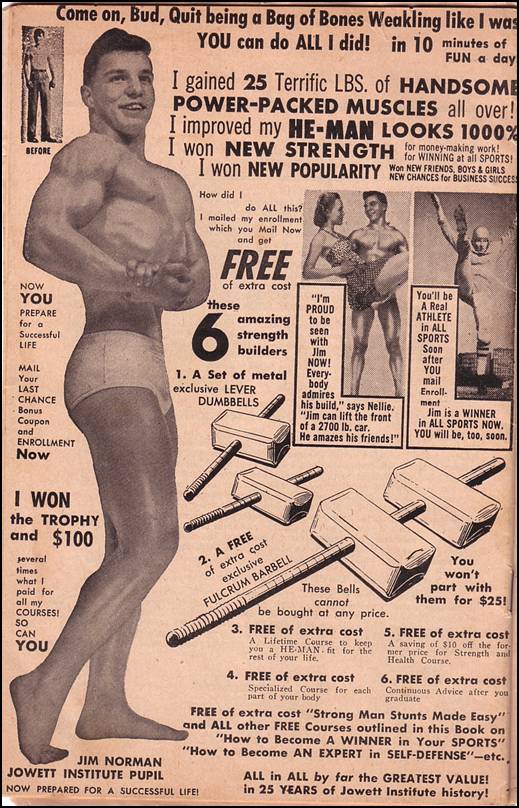
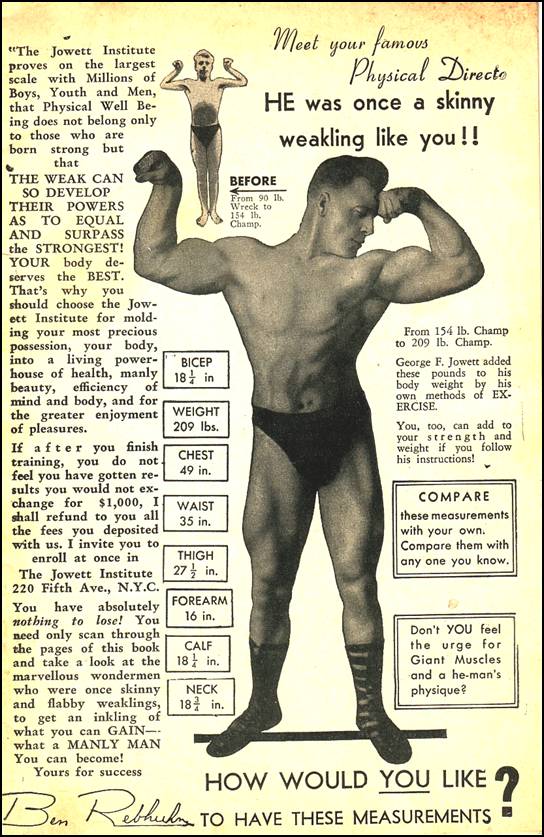
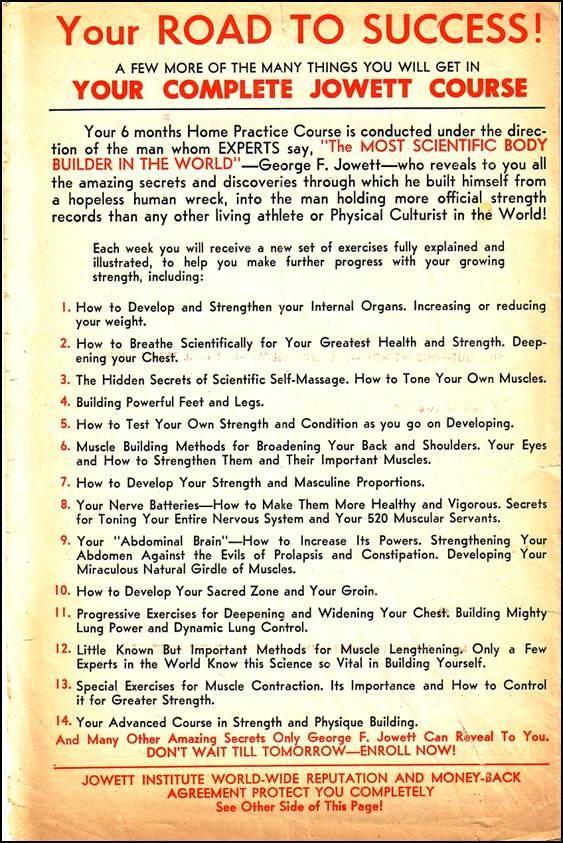
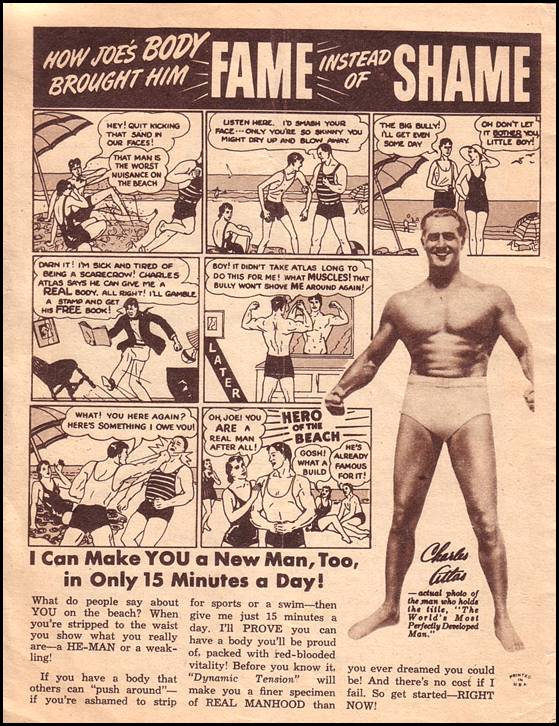
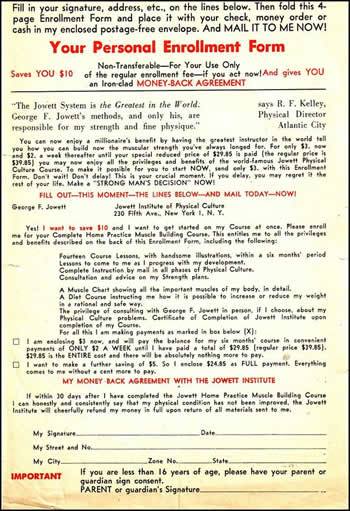
that I used to read the George F. Jowett and
Charles Atlas ads in the comic books all the time and
dream of looking like either one of them someday so I could get my evens
(revenge) with every one of those school yard bullies.
Finally after getting beat up for the
hundredth time and my eye glasses broken at least a half
dozen times I decided no more being weaker than a flea
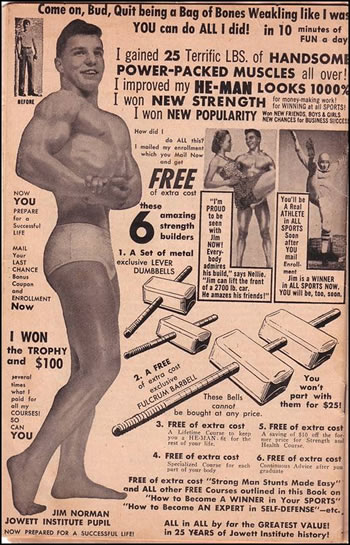
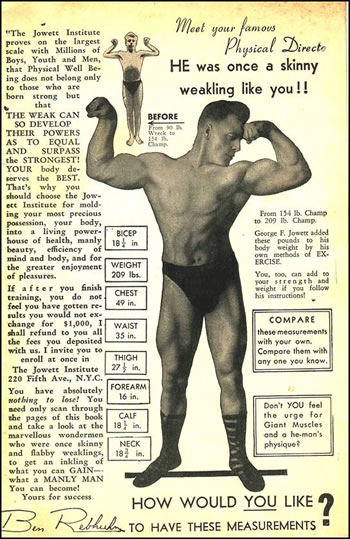
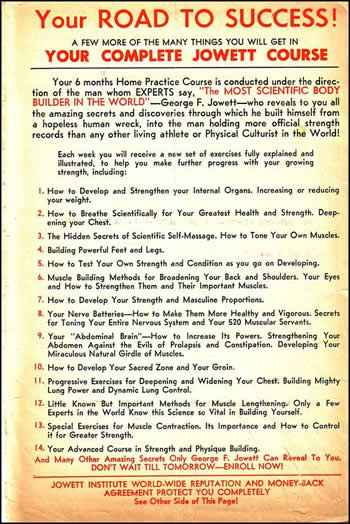
fart for me so… I responded to George F. Jowett's three-month power lever&Fulcrum Bell course ad.
|
|
|
|
 |
 |
|
 |
The Jowett course was the catalyst for surmounting
my physical weaknesses and overcoming my inferiority
complex but I still wasn’t the HE-MAN I envisioned myself
to be (I wanted to be Mr. Excitement with muscles and
a babe magnet all in one), BUT that all begin to change
suddenly one day when….
I walked into the local drug store here in my home town of Ketchikan, Alaska. I
was perusing the magazine rack and was shocked when I
saw the rugged and massive physique of Chuck Sipes on
the cover of the May 1962 issue of Joe Weider's Mr.
America magazine.
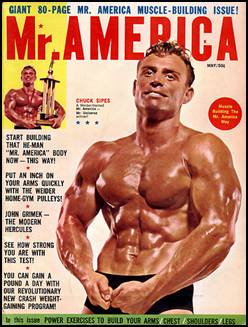
I immediately purchased the magazine,
safely tucked it under my massive 12-inch buggy whip
arm, and went home to read it from cover to cover. Without
a doubt this magazine with Chuck Sipes on the cover began a burning passion within for what
would come to be hardcore bodybuilding. My mom upon seeing
my passion bought me a set of weights from Sears & Roebuck
and I begin my journey into the world of “heavy iron”.
For the first 3 years of this journey I trained in the kitchen of my parent’s
home and the next 27 years in Spartan like conditions
in unheated sheds and warehouses where the temperatures
hovered in the teens during the winter months.
As a newbie bodybuilder I gleaned as much information as I could from
the Weider magazines but I
wanted to learn more. Around May of 1965 while reading
the Weider magazines I saw an ad for Chuck (Sipes)
American Bodybuilding Club. It only cost a measly $2.00
a month to have Chuck make up an exercise routine and
answer questions.
Having read articles by or about Chuck he became my bodybuilding hero
from the onset so I quite naturally and eagerly responded
to his ad. I began corresponding with Chuck Sipes through
letters and then phone consultations regarding the "how-to's" of
pumping the heavy iron for nearly 9 years until 1974. Later
(1976) when I became a bodybuilding journalist, I would
ironically write articles about Chuck Sipes for Peary Rader's Iron Man magazine.
|
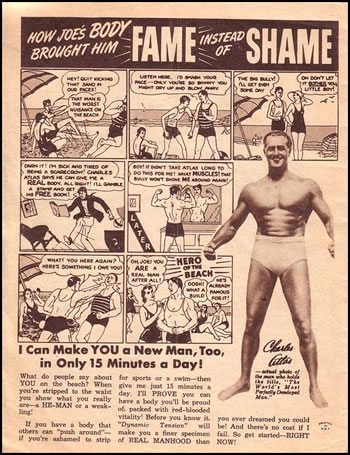
Ironically even though I was now bitten by the iron bug big time, the
Charles Atlas ads in the comic books still looked
very intriguing to me so…
I filled out the coupon, for the free 32 page booklet revealing the Charles
Atlas secret of Dynamic Tension, and mailed it
off.
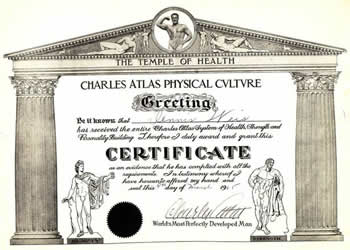
When the booklet arrived I was amazed by what I read so I ended up putting
$5.00 in an envelope and sent for the complete
12 lesson Charles Atlas course.
|
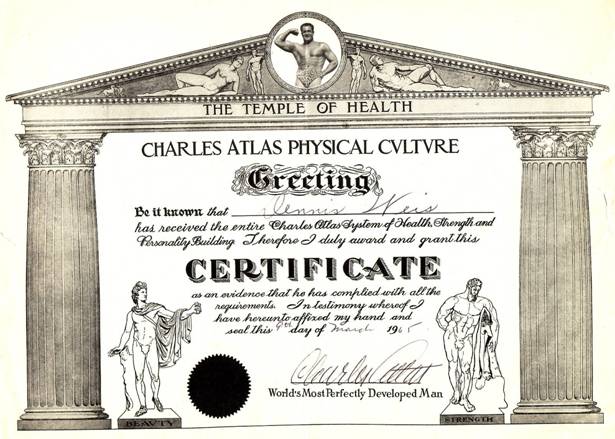
Log onto: www.charlesatlas.com
|
|
|
I must be perfectly candid here and say that while I did receive the above
certificate I didn’t train exclusively with the Atlas
12 lesson System of “Dynamic-Tension” but
used it in conjunction with my weight training. However
having said that I must say that the “Dynamic-Tension” exercises
offered in the Charles Atlas course did increase the
muscle gain factor (in my shoulders, arms, back and chest)
beyond what the weight training alone would have provided.
My burning passion for hardcore bodybuilding
was taken to a higher level
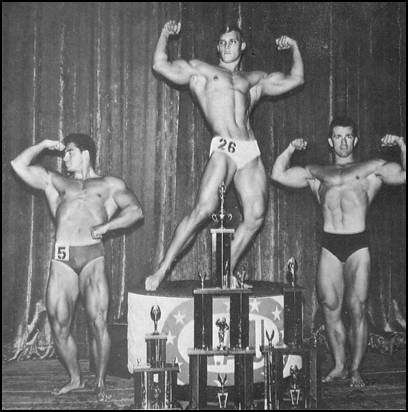
on June 11-12, 1965,
when I had the opportunity (as a spectator)
to attend the AAU Mr. America Contest
at the Embassy Auditorium in Los Angeles California.
Sergio posing at a contest
|
Here
I was in the big city; I must have looked like I just
got off the turnip truck. I accidentally walked backstage
at the Embassy Auditorium, during pre-judging of the
AAU Mr. America, and couldn't believe all the Herculean
physiques milling around. There was one huge black man
who stood out above all the rest, in my mind. Someone
said his name was Sergio Oliva.
I'm
lucky I didn't get the boot the way I was staring wide
eyed (like a deer caught in the headlights) and gape-mouthed
(like I was trying to catch flies) at all the giants
of bodybuilding of that time.
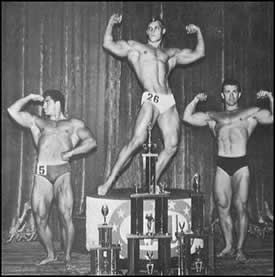
Randy Watson 3rd, Mr. America Jerry Daniels
and Bob Gajda 2nd
|
|
| My first Iron Man magazine |
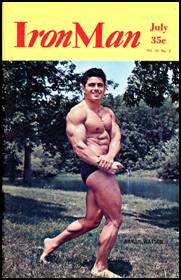 |
It was at this ’65 AAU Mr. America
contest that I became aware of the existence of Iron
Man magazine through the meeting of
Mabel Rader (Peary’s wife)
the associate editor. I flew back to Ketchikan and
began a new assault on my bodybuilding endeavors, armed
now with not only Mr. America magazine but Iron Man as well; they became my best friends and why?
I was the only person in Ketchikan crazy
or dumb enough to do the bodybuilding thing and more
than a few people made fun of me and even laughed at
my new found hobby at least to begin with. My Dad even
said I wouldn't amount to anything lifting the darn weights.
My Mom however gave me tons of encouragement to keep
lifting weights. Still being the only one around lifting
the weights I was as lonely as a fever blister on a snowball. But
that was about to change.
|
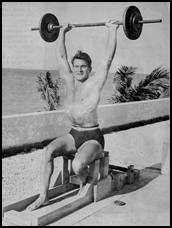 Rene Leger, a former Mr.Canada” Rene Leger, a former Mr.Canada”
performs Seated
overhead presses on the roof top gym at the Sandy Surf Hotel.
All of his personal friends in the
iron game including Charles Atlas and the great
John C. Grimek were guests
of the Sandy Surf Hotel from time to time. By the
time I arrived in Miami in 1966 the lease on the hotel had expired and Donne chose not to renew
because he had three other business ventures going
which were taking up plenty of his time.
|
|
|
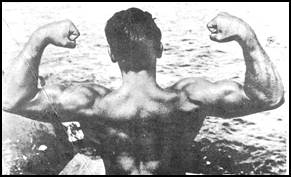
Donne in his physique competition days.
My burning passion for hardcore bodybuilding
excelled to an all time high in 1966, when I moved to colorful Miami Beach, Florida for
about nine months. It was my privilege to meet and become
close friends with Donne Hale, the East Coast “Bodybuilding
Guru”. Donne earned this title legitimately for he had studied
and experimented with all the recognized systems of advanced
weight training for the past 34 years and as a result the hundreds
of bodybuilders that trained under his guidance made, not normal,
but exceptional muscle gains.
A couple of years previous to my arrival
in Miami Donne owned and managed the ‘bodybuilding dedicated’ Sandy Surf Hotel
located at 89th Street and
the Ocean in Miami.
The Hotel included a unique rooftop gym.
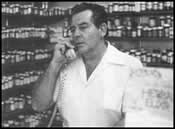 |
| Donne at his health food store. |
|
He was the publisher and editor of
The Florida WEIGHT – MAN (as well as being a noted author for Iron Man magazine) plus he owned
and operated ‘Hale’s Health Foods’ (which is still
going strong today in 2005), and ‘Hale’s Fitness
and Figure Gym’. |
Don’t let the words “…Fitness and Figure…” fool
you into thinking that Donne’s gym was for wimps. To begin
with there was Donne. Donne wasn’t just a look good on
paper “Bodybuilding Guru” but actually performed at a very
rugged strength level at age 44.
I remember seeing him casually pull
600-pounds cold (without any type of specific warm-up what-so-ever)
in the deadlift from just below the knees in a power rack.
Even more amazing was watching him
do a MAXIMUM REPETITION SET (one applied set where four or
more repetitions are executed with the most poundage involved)
in the non-apparatus Leg press (back in the early 1900’s this exercise
was called the “foot press”) with a 500-pound barbell. Wish
I had been camera ready for this exhibition of brute hips and
legs strength but I wasn’t so the following illustration will
have to suffice with the accompanying description.
|
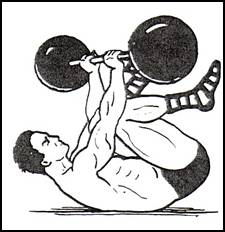
Don’t Try Performing This
Exercise Alone!!!
Always Solicit The Assistance
of a Couple of Savvy Spotters!!!
While lying on the floor
in his gym, and without the aid of spotters, Donne would
pull a barbell (400-500-pounds) to a position over his chest
and then bridge press it to arms length. From here he bent
his knees toward his chest (as depicted in the illustration
above) and placed the barbell evenly on the soles of his
feet. From here he extended his legs to a complete lock
out and lowered the bar back down, smoothly until the frontal
thighs were touching his chest. He continued extending and
lowering the weight in the manner described for a few more
reps. I am not too proud to say that I could never quite
master the balance involved (to say nothing of getting a
moderate weight of say 300-pounds up in position on the soles
of my feet even when I had the assistance of a couple of
workout partners).
|
The gym was brutally hardcore from
the get go and the hub for many elite athletes
from around the nation who were passing through
town. Five of the most hardcore dudes who trained
at Donne’s gym when I was there was mighty Ken
Newman, Len Lawson, Richard Franz, the late John
Carl Mese and Barry Popiel.
|
|
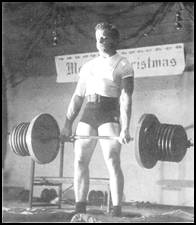
Richard Franz deading 628
lbs
Richard Franz was a 198 pound Olympic
and Powerlifter. He
became the national record holder in the deadlift at
around 650-pounds, but what really impressed me
was watching him do 110-pound Standing
dumbbell presses for sets of 10 reps and
with such ease. The only thing I could do with
the 110-pounders was the Dumbbell
Clean from “Hang” and that seemed to impress
Richard just a little. Richard had a bit of an
ego so he wasn’t often impressed by much.
|
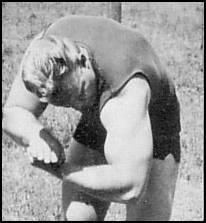
John Carl Mese contracting his 19+ inch upper arm.
John Carl Mese weighted
around 235 sported 19+ inch upper arms and could
do Flat barbell bench presses raw with 400+ pounds.
But what amazed me, for being a big man, was his
explosiveness to do the 100 yard dash in well under
11 seconds. In addition to the accomplishments
mentioned John also penned numerous articles around
1967-68 for The Florida WEIGHT – MAN (and later in the ‘70s became a contributing author for Iron Man magazine) the most noteworthy
in my opinion being a series of articles titled:
THE ARM FORUM.
|
|
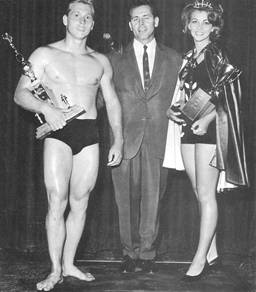
Len Lawson, 1965 teenage Mr. Florida |
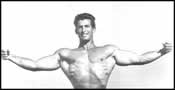
Mighty Ken Newman, 1963 Mr. Florida |
Barry Popiel really
impressed me at Hale’s gym. He had just turned 13 years
of age, and at 4’ 10” and at a bodyweight of 145 pounds
bench pressed 325-pounds and pressed 225-pounds overhead. If
I hadn’t seen these sensational lifts with my own eyes
and you were telling me this story I would have asked
you what you were smoking.
|
|
 |
There is one other person
who I should not
fail to mention
and that is…
|
|
Frederick
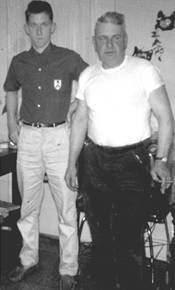
W. (“Doc”) Tilney– I met and befriended “Doc” Tilney when
I lived in Miami during my 9 month stay in Miami
in ’66-67.Obviously from the photo you can probable
guess that the late Frederick W. (Doc) Tilney wasn’t one of the hardcore elite bodybuilders who
trained at Hale’s gym. He was in fact a 70 year
old famous lecturer and author on physical culture. Over the span of his life he wrote
literally hundreds of articles on exercise and
nutrition for the Weider publications and other numerous bodybuilding magazines.
|
| Frederick W. (“Doc”) Tilney |
|
In addition to the articles he wrote
several books including YOUNG AT 73 and a nutrition book
used as a text at Oregon State University.
Doc Tilney revealed
to me that he had in many decades past formed a partnership
with Charles Atlas and wrote the famous Atlas course
plus the dynamic ads and sales materials associated with
it. Even though at this time I had no aspirations to
be a muscle writer it is still pretty cool to know that
I was in the presence of a prolific bodybuilding writer.
|
|
 Donne
seemed to sense early on that bodybuilding wasn't going
to be a short-term love affair for me. He realized it
was going to be a part of my lifestyle forever, and he
pulled out all the stops to supervise my training and
nutritional needs during the 9 months I lived in Miami. Donne
seemed to sense early on that bodybuilding wasn't going
to be a short-term love affair for me. He realized it
was going to be a part of my lifestyle forever, and he
pulled out all the stops to supervise my training and
nutritional needs during the 9 months I lived in Miami.
I must digress for a moment and say
prior to meeting Donne Hale I was self-taught through
the mainstream muscle magazines as to the “technique-emphasis” of
certain exercises. Actually, I did pretty well, but
it wasn't by accident, because I would wade through them
with a fine-tooth comb in search of highly guarded tips
and secrets.
I would buy any and all magazines,
books and courses pertaining to bodybuilding and powerlifting etc. There
were a couple of reasons for this.
First, I didn’t have many friends to speak of I sought refuge “Home Alone” 24-7 by reading and memorizing all
of the magazines, books and courses, page for page, while
the guys in my peer group was out dating the chicks and
partying big time.
|
Second, and most importantly I felt in the back of my mind that there was some
jealously-guarded bodybuilding secrets that I wasn’t
privy to relating to the discovery of a perfect workout
system for creating Unsurpassed Strength and a Massive…Symmetrical…Physique!
After 43 years of collective research I have found there
is just enough biomechanical and biochemical individuality
within each of us that “All bodybuilding programs work,
but some better than others,” and “All bodybuilding programs
work, but not all the time.”
Suffice it to say I had a HUGE bodybuilding
library. I still do! Only now I have hundreds of audio’s,
video’s, CD’s and DVD’s added to my bodybuilding library. I
wasn't called "Dennis, the Mail Order Maniac" for
nothing! I wish I’d had a copy of my eReport “Buyers
Beware” back then.
Enough digressing! Donne Hale's training
beliefs commanded my attention. He taught me not to
let my expectations get out of proportion. He said it
would take a lot of hard work and perseverance to succeed
in the iron game. I fired questions at him continuously
-- how much exercise, rest, nutrition?
|
|
 |
Donne
Hale’s gym:
Here
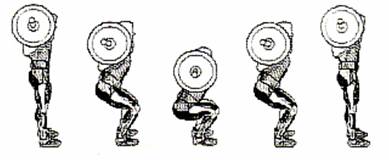
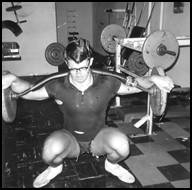
I am at age 20 warming up in the Barbell Squat using the Jackson cambered
squat bar. |
|
Donne had plenty of patience, and
with his tranquil demeanor he taught me to do multiple sets
of varying rep schemes using basic compound exercises such
as barbell-deadlifts, curls, bench
presses, bent over rowing, shrugs, calf raises, and full
squats. Full squats!!! What, I wondered, were those?
Up until arriving in Miami,
I was doing only upper body stuff. I soon found out
what full squats were after he loaded up the Jackson cambered
squat bar.
Donne had plenty of patience, and
with his tranquil demeanor he taught me to do multiple
sets of varying rep schemes using basic compound exercises
such as barbell-deadlifts,
curls, bench presses, bent over rowing, shrugs, calf
raises, and full squats. Full squats!!! What, I wondered,
were those? Up until arriving in
Miami,
I was doing only upper body stuff. I soon found out
what full squats were after he loaded up the Jackson cambered
squat bar.
|
 |
| Donne
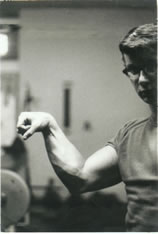
Hale’s gym: Posing my
forearm at 11:00 p.m |
|
My lungs felt like they had been ripped
out of my chest, and my legs felt like they had been fire-bombed.
This went on for a couple of weeks
during my squatting sessions. Donne's old-fashioned,
hard-core training instructions made Vince Gironda seem
like the late Fred Rogers (star
of the Mr. Rogers’ Neighborhood TV show). But, lo and
behold, all of a sudden, during a 20-rep squatting session,
I got an adrenalin/endorphin rush I'll never forget. From
then on, high-rep full barbell back squats would be my
core exercise for any workout.
I moved back to Ketchikan in
1967 and continued with a lot of extra incentive to train
in a 12x16-foot shed with no heat source. I continued
to correspond with Donne, Chuck Sipes,
and ultimately Peary Rader for years to come. These three men collectively
became my mentors for learning how to lift the heavy
iron and awakened my admiration for their well-rounded
lifestyles. They taught me to have tremendous ambitions
but not just in the physical realm. They said for most
people a 20-inch arm will not put food on the table or
money in the bank. They went on to say I must develop
mentally, socially and spiritually in order to achieve
success and happiness in life.
|
|
| What I learned especially from Donne,
Chuck and Peary could be summed
up as follows… |
I'd crawl out from under the weight,
rest five minutes and then squeeze myself back under
the barbell, drive it off the wood safety boxes to lock-out,
and then rack it. I'm not going to say it was easy,
because it wasn't. I was pooped and usually had to wait
20 minutes before I could do another repetition set of
squats. The best I ever came out of the hole with (without
having to unload some poundage) from a dead stop was
485 pounds at a bodyweight of 212-pounds
Of all the exercises I learned from
Donne, Chuck and Peary, the
one that they universally agreed was of paramount importance
was the Barbell back squat.
I learned that this exercise was the anabolic equalizer
for entire body when performed with perfect form and
motion and with lots of deep breathing and high-reps.
Eventually after a few years of doing this exercise I
was able to do 405 pounds for 20+ reps (without a specific
warm-up) while weighting under 215 pounds.
The value of this exercise has left
a lifetime impression on me and it is with this in mind
that I'd like to give some of the parameters that personally
prepared me eventually to do 20+ full reps in the Barbell
back squat with 405 pounds.
I rarely if ever used training gear
such as my rayon durene weightlifting
singlet, cowhide lifting belt (this wasn’t a stiff, thick belt like the ones used today, where it
takes the help of a training partner or two and the use
of a power rack to get it buckled) or York Barbell lifting shoes when squatting in training
-- loose-fitting York Barbell Club maroon training pants,
and a pair of tennis shoes (with a good support base)
was fine for me. During the cold winter months I would
wear a pair of BH (Bob Hoffman) rubber-like Knee Bands
to keep heat and circulation around the vulnerable knee
joints.
I was anatomically blessed to squat
deep and I never had any knee, back, or Achilles tendon
injuries associated with doing them. Squatting deep for
me was when the tops of my thighs were below parallel
and beyond.
|
| 1. |
Always do general and specific
warm-ups. |
| 2. |
Do heavy non-injuring compound core exercises such as; Barbell Back Squats, Flat Barbell Bench Presses, Conventional Deadlifts, Barbell Bent Over Rowing, Barbell Clean & Press, Standing
Barbell Curls, Vertical Dips on the Parallel Bars. |
| 3. |
Always include some neck, forearms, abs and calf exercises. |
| 4. |
Maintain a balanced diet of natural foods. |
| 5. |
Get adequate rest and |
| 6. |
Maintain a tranquil mind. |
| 7. |
There is no magic bullet
for developing the ultimate physique especially if
you are an anabolic drug-free bodybuilder. |
| 8. |
Bodybuilding success demands
that you put forth a valiant effort and determination. |
Strong erector spinae muscles,
of the lower back, is necessary because they work in
conjunction with the squatting process. I developed my
lower back strength to the point where I could pull 500+
pounds in the Conventional
dead lift (without any
specific warm-up what-so-ever) for an initial
set of 10 reps. I did these standing on a raised wood
platform where the bar touched my instep. As well, to
be strong up the middle, I would do 60 reps in the Roman
chair sit-up (a no-no by today's standards) with 60 pounds
for that little extra boost in abdominal strength.
For years (especially when I was in
hard training for powerlifting & bodybuilding competitions
in the early 1970s) I didn't
have a training partner (spotter), so on an exercise
like the deep Barbell back
squat I would use wood safety boxes (to dump the
barbell on) if I got stuck in the bottom position.
|
|
|
|
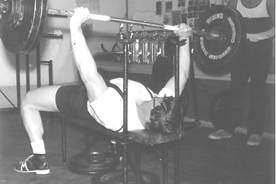
The rarest of the rare, an actual photo
of me Bench pressing (around 275-pounds).
|
|
Strong erector spinae muscles,
of the lower back, is necessary because they work in
conjunction with the squatting process. I developed my
lower back strength to the point where I could pull 500+
pounds in the Conventional
dead lift (without any
specific warm-up what-so-ever) for an initial
set of 10 reps. I did these standing on a raised wood
platform where the bar touched my instep. As well, to
be strong up the middle, I would do 60 reps in the Roman
chair sit-up (a no-no by today's standards) with 60 pounds
for that little extra boost in abdominal strength.
For years (especially when I was in
hard training for powerlifting & bodybuilding competitions
in the early 1970s) I didn't
have a training partner (spotter), so on an exercise
like the deep Barbell back
squat I would use wood safety boxes (to dump the
barbell on) if I got stuck in the bottom position.I'd crawl out from under the weight,
rest five minutes and then squeeze myself back under
the barbell, drive it off the wood safety boxes to lock-out,
and then rack it. I'm not going to say it was easy,
because it wasn't. I was pooped and usually had to wait
20 minutes before I could do another repetition set of
squats. The best I ever came out of the hole with (without
having to unload some poundage) from a dead stop was
485 pounds at a bodyweight of 212-pounds.
At times I would do slow single rep
negative Barbell back squats with
550-600+ pounds down to the wood safety boxes. I'd then
have to crawl out from under the weight, unload the bar
to around 225 pounds, power clean it and rack it onto
the squat stand apparatus. I’d reload the bar to the
amount of weight that I would be using next. After a
short rest-pause I’d do the next single rep negative.
This was a most time consuming procedure to say the least.
While my squats were decent, pressing
movements of any type were sub par and worse. For example
my best Barbell press overhead for
a triple was 225 pounds and my bench presses SUCKED even
more!
|
It was a lucky day if I could bench
press 300 for a triple, and then I would need a 3/4 ton
hoist and David Copperfield (the magician) to help me
levitate the bar up. Maybe that's why I never excelled
at benches. I had the 3/4 ton hoist but Copperfield
was just a kid back in the '70s.
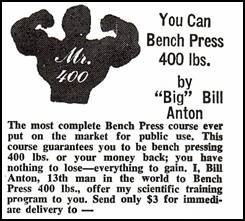
| Seriously I tried every bench press program offered such as… |
|
|
See ADDENDUM
SECTION for
an outline of :
You Can Bench Press 400 Pounds |
None of the programs catapulted me
beyond a paltry 325-pound max single. Interestingly
though the poundage that I used in the associated ancillary
exercises would suggest that I was capable of a 350-375-pound Bench press but it was not to be. I know that when
actually performing the Bench
press it was like a light switch being shut off
mentally in my head. But just ask me to demonstrate some
really heavy back or leg work and it was just the opposite. Enough
about my pathetic bench pressing!
I want to talk in more detail about
the Barbell back squat.
Fifty percent of the time I would use a conventional
straight bar for squats, and other times a Jackson cambered
bar (weight is carried lower in the center of gravity). I
always padded the bar with Armoflex (a
pipe insulating material).
|
|
Eventually these commando-tough workout
sessions got me to the point where I was able to do 20
rock-bottom Barbell back squats with 405 pounds (in pause squat
style), without a warm-up of any kind. I wrote about
it in a series of articles for Iron Man magazine
in the late '70s, entitled "Bits of Advice & Routines." Then
a funny thing happened. . . .
One evening during the late 1970s,
in the month of June, I heard a knock at my door. I
opened it and saw two guys in their early 20s. My first
though was, “Oh, great, I’ll bet these two are going
to tell me they are selling fur-lined bathtubs or,
worse yet, Air in a Jug.” They said, "Are
you Dennis B. Weis?" to which I replied, "If
you're from a collection agency or the IRS, then No!"
They assured me they were from neither,
so I admitted I was in fact the person they were seeking. They
went on to say that they were up here (Ketchikan, Alaska)
on a commercial fishing boat from San
Francisco and wanted to stop by and chat about bodybuilding and fitness, since they were avid readers of Peary Rader's Iron Man magazine.
They had read in my "Bits of Advice & Routines" series
that I could do full Barbell
back squats with 405 for 20 reps without a warm-up,
and they said, quite frankly, “We didn't believe it!” A direct
comment such as this might irate some people as it could
be a reflection on their truthfulness as a writer per
say. One of my favorite motto’s was (and is to this
day) “An ounce of action is worth a pound of talk” so
I found their comment challenging in a positive way.
I remembered writing that in the article,
but I said that while I was capable of that feat, it
didn't necessarily mean that it was an everyday occurrence
that could be done at any time during, say, a five-year
span. Peaking levels vary, but I told them they were
in luck because I was indeed in shape to perform 405
pounds for 20 reps.
We left the house and walked down the
road a couple of blocks to my 12’ x 16' workout shed
and went in. There was just enough light coming in
through the windows, even though it was late evening,
which meant I didn’t have to crank up the propane lamp. I
was lucky it was June and not December so I didn’t have
to scrape off frost from the bar. I directed their attention
to my squatting apparatus, a York portable dip bar attachment hooked to a Peter Dodge Dynatron A-Frame.
|
Over
the years I used a number of training programs
to accomplish my goals of squatting 20 reps with
new poundages. Below,
are a couple of them:
|
|
No. 1
On this program I would do 5 sets of 8 reps in the power-style
squat with 84-88% of my current one-rep max. I still
squatted very deep but carried the bar low on my traps
and used a shoulder width foot placement. I was explosive
on these. After completing the 5 sets, I would drop
back to 60% of my one-rep max and do one set of 10
reps in Olympic high bar style, with my foot placement
no more than 12 inches apart. Each workout I added
two reps more than the previous, until I reached 50-60
reps. I trained twice a week.
|
No. 2
This program is a Peary Rader special. I
would take a poundage with which I could barely get
10 full reps and with a lot of mental tenacity (and
4-5 deep breaths between reps) would finish out with
20 reps in pause squat style. This was done twice
a week. I'd add weight whenever possible, say, 5-10
additional pounds once a week, and just keep grinding
out 20 reps, but just for a couple of sets per workout.
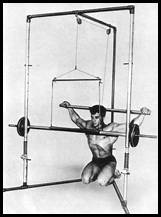 |
Dynatron A-Frame
|
|
Two wood safety boxes were
positioned nearby. I asked the guys to count up the weight
on the squat bar (that was resting atop the dip bars), “And
don’t forget to include the weight of the bar,” I exclaimed. They
counted 405 pounds. I could tell they were surprised that
it was loaded and ready; I told them it had been this way for
a few months. I didn’t have training partners, so I could
leave equipment as is.
I asked them to stand back as I prepared
to squat. I took 20-30 seconds and mentally, through
visual imagery, saw myself successfully completing 20
deep squats with perfect motion and form. I was getting
an inner rush, so I knew I was ready. What follows is
my…
|
___________________________________________
PSYCHOLOGY OF THE 20-REP BARBELL BACK SQUAT |
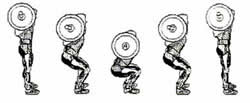 I approached the squat rack, grabbed
the bar about 6 inches wider than shoulder width, with
both hands. I dipped down slightly so that I could
center the bar high across my traps. Then I stood up
with the weight and methodically but vigorously stepped
back from the squat rack, taking no more than two steps
with each foot. I spaced my feet about 12 inches apart
(where I felt the strongest) and rotated them out laterally
from parallel at about a 45-degree angle. I locked my
legs, arched my back, tightened my abs and made sure
my chin was parallel to the floor. I was now ready to
begin the first of 20 reps in the standing pause squats. I approached the squat rack, grabbed
the bar about 6 inches wider than shoulder width, with
both hands. I dipped down slightly so that I could
center the bar high across my traps. Then I stood up
with the weight and methodically but vigorously stepped
back from the squat rack, taking no more than two steps
with each foot. I spaced my feet about 12 inches apart
(where I felt the strongest) and rotated them out laterally
from parallel at about a 45-degree angle. I locked my
legs, arched my back, tightened my abs and made sure
my chin was parallel to the floor. I was now ready to
begin the first of 20 reps in the standing pause squats.
I took a huge, deep breath and proceeded
to squat down to rock bottom. I know from practical
application where my below-parallel rock bottom position
is so I can squat in one smooth motion without worrying
about having search for the bottom position. My negative
or eccentric speed took about 4 seconds per rep going
down. I never considered squatting to where the tops
of my thighs were only just parallel to the floor. I
never experienced any sacroiliac danger or knee joint
injury squatting rock bottom, although this might not
be the case for many squatters. I suspect my controlled
descent was partly responsible for this, as opposed
to the dive-crash or collapse style descent.
As I descended, my shins almost always
extended over the instep of my feet, but no further. Immediately
upon reaching rock bottom I would begin the ascent
upward, still holding the deep breath of air. As I
moved out of the squatting pocket, I always led with
my head and chest to keep my hips from rising too fast. I’m
really fighting the mindless weight up, and this of
course is only the first of 20 reps. Remember, I’m
doing these suckers without a general or specific warm-up
of any kind, so I expect the first few to be brutally
hard, vein-bulging efforts.
As I near the top of the movement,
there is less strain, so I expel the air. It took
me about 3 seconds to complete the positive or concentric
phase of the rep. I breathe in 3 huge breaths quickly,
grit my teeth and grind out another rep.
|
I continue on in this manner for 8
more reps – three deep and determined breaths and do
the rep. Finally, at rep 10, it starts to get easier,
because I’m finally getting warmed up.
This goes to around rep 14, and I start
to fade a bit, so I start taking 6 breaths between each
squat. I of course never racked the bar during the pauses,
and while it allowed the blood to free up and circulate
through the thigh muscles for a rejuvenation effect,
the spinal erectors were always under tension and swollen
beyond belief at the end of a set.
After the completion of the 20th rep
I stepped forward and racked the bar. I never counted
from 1-20 when doing the reps but would in my mind divide
the whole thing into two 10-rep sets. I’d count 1-5,
then the next five I’d count backwards from 5 to 1. That
left 10 reps to go. From here I’d radically change up
these remaining 10 reps. I’d say to myself, “I’ve got
just 3 triple sets to go and one single.” I’d do 3 reps,
then I’d say “I have only 3 sets of doubles and one single.”
I do two doubles and finish off with
three singles. This mental exercise in counting worked
for me then and still does today. I really varied this rotating
reps countdown mind game once when on a bet for a
hamburger I full-squatted 300 pounds for 75 reps. I never
worked so brutally hard for a hamburger in my life. Never
again! I’ll buy my own hamburgers from now on, thank
you very much. J
Regarding the numerous rest pauses
that I took between some of the varying reps of the set,
some people might say that deliberate rest pauses between
reps make the set less impacting than doing a set where
there is only one deep breath and no more taken between
each rep. This is speculative at best, because the bodybuilder
who is used to taking only one breath between each rep
may not fare any better by taking 3-6 huge breaths between
reps and may even do worse, and vice versa.
The two guys from San
Francisco were impressed with my 20-rep feat and heartily congratulated me. They
appreciated the fact that I could back up the claims
I had made in the Iron Man article.
|
|
Imaginary Lifter Technique
|
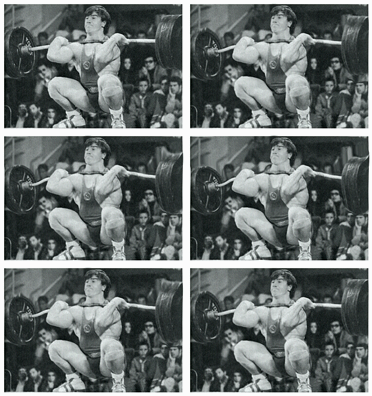 |
| Elite Soviet lifter Dave Rigert, a holder of 54 world
Olympic lifting records in the ‘70s
is hoisting nearly 500-pounds |
|
|
Previously I mentioned the fact that
for many years I never had the luxury of a training partner
to spot me for my squatting movements but yet I was able
to make continued gains in workout poundage and rep increases
in this and other exercises. This was possible in part
because of a technique I used which I called the imaginary
lifter.
For example when I was getting ready
to do the Barbell back
squat with 405-pounds for 20 reps I would see
an imaginary elite Soviet lifter (David Rigert was my favorite), of the same bodyweight as myself,
competing against me right there in my 12 x 16 workout
shed.
I would imagine in my mind that we
were competing for a world championship and that he had just
completed 19 reps with 405-pounds in the Barbell
back squat. My goal then was to do at least one more
rep than the elite Soviet lifter and the world championship
would be mine, so I would do the Barbell
back squat with 405-pounds for 20 reps.
Sometimes however if I wasn’t into
a particular squat workout mentally I would have the
imaginary elite Soviet lifter, Rigert,
winning the world championship. But let me tell you
that really fired me up for the next squatting session
to not only beat the imaginary lifter but exceed my own
PR in poundage lifted or reps increased.
Actually I used the imaginary lifter technique
with tremendous success on all the compound core exercises
mentioned before with the exception of the Barbell
bench press.
A crazy technique? Maybe but it seemed
almost perfect for me during the years I was training era appropriate 3-3.5 hours 5-6 days a week
for powerlifting & bodybuilding
competitions back in the ‘70s because I never saw any
signs of going stale training wise and my enthusiasm
grew steadily, never declining. Perhaps some of you
can profit from the Imaginary Lifter Technique.
|
Epilogue
When I first started pumping the iron
as a weak, skinny teenager I couldn’t help but notice
the little regard people in general gave me. They might
give me a little tiny nod of the head and with eyes downcast
hurried on by, too busy to talk and if they acknowledged
me verbally it was almost a lip synch whisper of “Weis!” compared to the gregarious greeting of “Hi Guys!” they gave to others.
Most of the time though no greetings
were exchanged and we were like two ships passing in
the night. And if there was two or more of them together
they’d all ignore me and act like they didn’t know who
I was.
However when I began packing on pounds
and inches of muscle naturally on my skinny frame people
stopped exploiting me and I started really winning their
respect.
This was never more evident that when
I won some State powerlifting competitions
in the early ‘70s. And all those previously doubting
people, many of whom looked like they were weaned on
a dill pickle and others who looked like the deadpan
Jon Arbuckle from the Garfield comic’s, were now wildly
congratulating me, and reaching out to give me the glad
hand or slap me on the back in their enthusiasm.
Even my dad, who had previously given
me little encouragement, was showing my iron game trophies
to his friends out in the front yard. Needless to say
I now felt confident and successful. 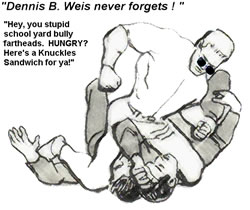 And those school yard bullies I mentioned
earlier? After my second year of high school they never
ever bothered me again!!! And those school yard bullies I mentioned
earlier? After my second year of high school they never
ever bothered me again!!!
What you have just read is a personalized
glimpse and glance into my world of bodybuilding in the
early years. I am proud to say that my personal accomplishments
in the iron game have been achieved as an anabolic drug-free
power-bodybuilder. |
My Story-The Early Years
can be expressed
in the following formula:
Weak + Skinny + Timid + Insecure + Loser = Hoist the Heavy
Iron + Read the Magazines 24-7 + Learn the Secrets
of Bodybuilding + Applied
Knowledge + Competing Power-bodybuilder + Confident & Successful.
|
|
ADDENDUM SECTION
The Successful Bench
Press Blueprint
By John
Carl Mese
As Told To: Dennis B. Weis “The Yukon Hercules”
THE ARM FORUM-5
By: John Carl Mese
You Can Bench
Press 400-Pounds
|
| |
Blueprint
by John
Carl Mese
As Told To: Dennis B. Weis “The Yukon Hercules”
|
|
If you want to increase your bench
pressing strength, and continue to increase
it for years to come then try this routine
by my friend, the late, John Carl Mese,
a natural 400-pound plus bench presser.
Using his program you can steadily
up your bench press approximately 10 pounds
a month. Here is how The Successful Bench
Press Blueprint,
was performed by the late John Carl Mese
|
|
|
| Step No. 1- |
Warm up -with a light poundage for 1 set of
10-12 reps.
|
| Step No. 2- |
Then -do two intermediate sets of just
2 reps each. The first set, use a poundage that is 1/3 of the way up
to your 2 rep limit, from the warmup
|
| Step No. 3- |
Now -jump the poundage to the absolute
most you can do for two reps and perform two
sets of 2 reps each. As your training energy
and efficiency increases from workout to workout try for
a third sets of 2 reps and eventually do four
sets of 2 reps
|
| Step No. 4- |
Next -decrease the two rep poundage by
20 or 30 pounds which allow you to make two sets of 4-6 reps. Be sure
that you are able to get a minimum of 4reps,
and really make a concentrated effort to
accomplish 6 reps on each set.
|
| Step No. 5- |
Again -decrease the poundage another 20
or 30 pounds and blast out two sets of 6-8 reps. This completes the barbell
portion of the bench press program. Finish-off with Incline Dumbbell
Presses for three sets of 8 reps. Start heavy and work light in 10-15
pound jumps. You need to hurry on these to keep blood in the pecs.
This completes the Monday
and Thursday workouts.
|
|
Tuesdays and Fridays
|
|
Doing assistance exercises for arms,
shoulders, and back strength is a systematic way
to develop more bench pressing power. Generally
two assistance exercises are done on Tuesdays
and Fridays.
|
|
The first assistance
exercise is the Seated Barbell Press Behind the Neck and uses
the same set and rep scheme as described in Steps
No. 1-5, listed on the previous age, for the bench
press. The second assistance exercise
is Vertical Dips on the Parallel Bars and is performed
for five sets of 8 reps. In all, keep your training
intensity up by adding additional weight to your exercises
whenever possible.
Capsule Comments
about Assistance Exercises
for the Bench Press
Most generally, assistance exercises
are tailored to certain specific weaknesses in muscle development
and strength. For example, if your sticking point is on
the chest (as it rests) you could be lacking in back strength
which is necessary since the lats help
drive the bar off the chest. In this case you will want
to choose 1-2 exercise variations for the lats such
as deadlifts and do four sets of eight reps, although varying
the sets, reps, and poundages used
can be beneficial providing they allow the lat muscles
sufficient overload quality for development.
Other suggests for the sticking point on
the chest would be: Watch your form by keeping your
body tight. Explode the weight off the chest by doing
precise flat starts. Do ½ reps with 50-100 pounds under
your current one-rep maximum, exploding the weight off
the chest 6-10 inches for one set of 10 reps and a second
set of 20 reps. Drive the bar up in an “arc” rather
than straight up (too much triceps).
A sticking point at mid-chest can
indicate that you are simply out of the proper tracking
pattern groove in which you must then expel the air forcefully
out of your lungs to bypass this sticking point. Front delt weakness
could be a problem, and here you could Dead-Stop
Benches in a power rack using a beginning pressing
range which is 5-6" off the chest, or perhaps you
can do Barbell Front Raises for the delts.
Sticking point near lockout
can be from fatigue, form, or weak triceps. One of the
best exercises for this muscle is to perform Reverse
Grip Bench Presses. Lower the bar down to your
abdominals (not the chest) and press straight up from there
(not in an “arc” back toward the bench upright supports
as in the conventional bench press). Do a set of 5 reps,
then immediately reduce the weight by 30-40% and go to
absolute positive failure! This is one series. Do 2-3
more.
|
|

Presents The Series Titled: |
|
|
THE
ARM FORUM # 1
EDITOR’S NOTE: Since arms are so popular, this new feature should be
welcome. Arm routines and problems will be discussed,
great armed men presented.
|
| One of the top arms today – ranking
with those of Ortiz, Scott and Pearl – is that of DAVE DRAPER. |
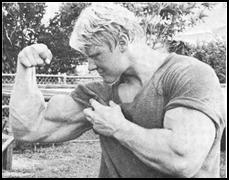 |
Some
idea of DAVE DRAPER’S great arm can be gained by studying this photo – taken under
clouded skies by
John
Carl Mese
|
|
|
In that group, Dave’s arm is most similar
to Ortiz’s with his high peaked biceps. He also displays
a remarkable crisscross effect in that muscle and you’ll
see what I mean if you study the accompanying pose. Although
Draper doesn't possess abnormal definition, he has terrific
muscle separation, resulting in this crisscross. Tremendous
size is his, naturally, but he has real muscle hardness,
as well. I asked the blond giant if his arm really was
20 ½”, as reported in other magazines. He stated he HAS
NOT MEASURED HIS ARM IN THREE YEARS! Still, at his height
of 6’ 1”, I feel his girth is at least an inch more than
my own and must be 20”, plus.
The first thing you notice about Dave
is his huge forearm; it is easily in a class with that
of Scott, Pearl and Sipes. He
is a believer in working on the forearms as a separate
body part and has made them outstanding. But how does
he train his arms? Does he really follow “space age methods”?
Draper trains biceps, triceps and forearms
three times a week. He works very fast and averages 15
sets per arm part. He concentrates and adjusts each movement
so he is getting the proper feeling or pump, as he believes
this is vital. He admits he has trouble with the triceps
and notes that he has a hard time getting a pump in it. Here
is one of Dave Draper’s routines:
TRICEPS
|
|
| |
Lat
machine pushdown
French press, lying
Tiger bend pushups
|
– 5
sets, 8-10
– 5 sets, 8-10
– 5 sets, 8-10 |
BICEPS
|
|
| |
DB curls, lying
DB curl sitting
DB curl on incline
|
– 5 sets, 6 reps
– 5 sets, 6 reps
– 5 sets, 6 reps
|
FOREARMS
|
|
| |
Reverse curl w/BB
*One-DB
wrist curl
[With upper arm parallel] |
Supper setted 5 series, enough reps for burn |
| |
*One-Dumbbell
(palm up) Wrist Curl [With upper arm parallel]
|
|
Weight training devotees are constantly looking for a “secret
exercise” or (even more exciting) a “secret routine” that
is used by a famous star. It’s impossible to convince
the average man that champions simply were born with ideal
potentials and then worked very hard to develop those natural
gifts to the limit. He’s much happier believing that he
too would be great IF…..if only he could learn that secret
method used by his idol! To partially please those dreamers,
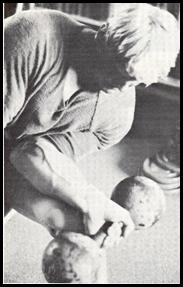
here is the unusual favorite exercise Dave Draper used
in building his tremendous forearms.
Modestly, Dave doesn’t claim credit for the movement, saying
Chuck Sipes originated and taught
it to him. It is a variation of the old fashioned wrist
curl, using a dumbbell, but one little change makes all
the difference. The starting position is the same – the
forearm is laid along the top of the thigh, with the hand
and lower part of the wrist extending off the end of the
knee. Now, look at the photo on the left. The torso is
now twisted a bit, to bring the shoulder of the working
side closer to the wrist. Continue leaning forward and
to the outside until the upper arm of the curling hand
is parallel to the floor, or as near as you can make it. Remain
in this position while you perform the regular dumbbell
curl, concentrating strongly.
Drooping the shoulder and upper arm forward in this manner,
puts the forearm in an unusual position too. You’ll notice
a much stronger effect on the inner part of the arm and
a quick improvement in the “gooseneck” formation when you
flex the forearm. Give this “secret movement” a trial – it
has evidently worked well for both Draper and Sipes!
So you can see it does not
take magic to have terrific arms. Hard work and dedication
has been the pattern followed by Dave Draper and he’s reaping
big results!
|
THE
ARM FORUM # 2
Flushing methods have been subjected to a lot
of criticism in the past. Sometimes, I admit, they have
been misused. Youngsters like the ‘pumped up’ feeling
they give and never bother to do any other type of work. This
is definitely the wrong way to benefit from them.
When it comes to adding size
on the arms, the flushing approach is excellent, when used
occasionally. This method will often surprise you by making
your arms become harder and more defined, at the same time.
If you are at a sticking point
and those ‘space age methods’ are not making your arms
a bit larger, try this routine for a six weeks period. I
(JOHN CARL MESE) have
used it with good success on many occasions. Here is how
it works.
Take three or four triceps
exercises that suit you. Perform one set of each, one
after another, in rapid succession. When you have done
each of them once, this will be one group set. Take a
brief rest and then repeat this group set, using as many
reps as you think are right for you. Since sixteen sets
of triceps is usual for me, in this case, I use four of
these group sets.
| Here is a sample routine that I have used: |
| |
Dips with weight |
6 reps |
| |
Pushdown on lat machine |
8 reps |
| |
Close grip bench press |
10 reps |
| |
1 Arm dumbbell extension |
10 reps |
For those biceps, here’s another good one:
|
| |
Barbell curl (or E-Z bar) |
6 reps |
| |
Dbell curl,
thumbs up |
8 reps |
| |
Concentration curl |
10 reps |
In
biceps work, I usually perform twelve to fifteen sets,
so this above routine is repeated for four or five group
sets. In both the biceps and triceps work, you must learn
to work as rapidly as possible, with a minimum of rest
between the group sets and none at all between the individual
exercises that make them up. Great things do happen to
your arms when you work this way about three times a week. In
my own case, I usually train the arms on my shoulder day
and this works out very well.
Give the flushing methods a
real try, on your choice of favorite exercises and I am
sure you will be pleasantly surprised. Until the next
issue, happy muscle flushing!
|
THE
ARM FORUM #3
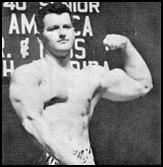 |
Here RICHARD PRUMER shows two
views of his fine arm development.
A very high biceps but I think you’ll
agree ALL of his arm merits praise!
|
|
|
I
first noticed RICHARD PRUMER at
the Mr. South Florida contest and for a good reason! He
certainly had the finest arm in the show and one of the
highest peaked BULKY biceps I’ve ever seen. I learned
he won the Mr. Carolinas title in 1966 and is currently
in the Air Force. At twenty-two his enthusiasm is high
enough that he can still train hard, and he does.
Usually, Prumer manages four sessions per week. If he’s getting ready
for a contest he pushes that up to six a week. On his
four day schedule, two days are devoted to legs, chest
and triceps. The remaining two cover the shoulder, back,
forearms and biceps: waist work is done every day. Though
Richard is well developed all over we’re particularly interested
in the very fine arms, so let’s take a look at his arm
favorites.
TRICEPS
|
|
| |
Lying Triceps Ext
Lat Machine Pushdown
Dips with Weight
|
5 sets, 8-10 reps
5 sets, 8-10 reps
5 sets, 8-10 reps |
BICEPS
|
|
| |
Gironda DB
Curls
Incline DB Curls
Lying Concentration
DB Curl on Incline
|
5 sets, 6-8 reps
5 sets, 6-8 reps
5 sets, 6-8 reps
|
FOREARMS
|
|
| |
Regular Wrist Curls
Reverse Wrist Curls |
3 sets of 20 reps
3 sets of 20 reps |
Richard
is a believer in very strict form for all his arm work
and concentration rigidly, as well. He couples that with
medium speed for his training. A big protein eater, he
also eats at least one pound of cottage cheese everyday.
One
hundred and ninety pounds, 18 ¼” arms, 15” forearms (both
taken cold) - these are the vital statistics for Richard Prumer. He
has steadily worked his way up to the point where his arms
are tops in any company. We’re pleased to salute him in
this column and predict you’ll be seeing much more of him,
in the future
|
|
THE
ARM FORUM #4
|
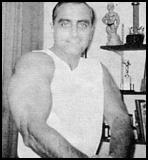 |
ROGER
SERVIN displays the fine
arm he has attained using the “comfortable
approach” to training. It is more
than 17” despite small bones
|
|
|
Many bodybuilders train hard
and for long enough to be handling the same poundages in their arm exercises as the top men. Why don’t
they get the same results? Differences in basic body types
must be considered, but I still think an important point
is concentration on the movements used. I have always
emphasized this in discussing arm programs and there is
plenty of evidence to back me up.
One of the exponents of the ‘get
the feeling’ school of bodybuilding is ROGER SERVIN. Starting with a very small frame,
bad health and tiny bones, he had to work hard for results. He
finally became Mr. Pennsylvania, a cover man and placed high in more
than one Mr. A. For many years, he thought that straining
with heavy weights was the route to a great physique. He
continued to push his exercising poundages higher,
was an active lifter and really STRAINED to achieve gains. Finally,
recurring injuries and strains in many body parts slowed
him down and forced a change.
For the past half dozen years, Servin has
reversed himself, training comfortably; he has made a point
of finding the most pleasant movement to use for each purpose. He
has then used those exercises in a careful manner – moderate
weights, extremely correct performance and, above all,
concentration.
|
His goal
has not been exhaustion but the ‘feel’ of each repetition
and the amount of pump they caused. Results on his arms
have been greatly increased since adopting this pattern,
even though he is an older man who should progress slower.
When Roger
was training at the Sandy Surf a few years ago, I noticed
that his workouts seemed so enjoyable it was almost a
sin.
TRICEPS (30
minutes)
|
| |
Lying extensions to forehead
Barbell extensions standing
Dbell extension lying, across body
Dips
|
5 sets, 8 reps with 85-lbs. 5 sets, 8 reps for 65-lbs.
5 sets, 10 reps with 30-lbs.
2 sets of 15 reps |
BICEPS (30
minutes)
|
|
| |
Barbell curls
Alt. DB curl seated
Concentration DB curls
Forearm curls
|
5 sets, 8 reps with 85-lbs.
5 sets, 8 reps with 30-50 lbs.
5 sets, 10 reps with 30 lbs.
6 sets, 20 reps
|
Phil trained fast and used the one
minute rest between sets and exercises. At the contest,
he displayed a peaked biceps, real horseshoe triceps and
an excellent balance to his arm. With his incredible cuts,
it was very impressive. By the way, he placed third in
Best Chest and fourth in the Best Back divisions. If PHIL
ZIMMERMAN could do so well on this routine, maybe
it will be worth a try for you.
|
|
YOU CAN BENCH PRESS
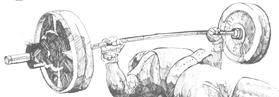 400-POUNDS
|
1. FIRST
YEAR – FIRST PERIOD (3-months)
Take a weight you can handle fairly easy for 12 repetitions
and perform 10 sets. Each
week add 5 pounds to your previous weight. If you find
that after awhile you can not continue to add weight, stay
at the present weight you are using until you can perform
the 12 repetitions – 10 sets.
FIRST YEAR – SECOND
PERIOD (3-months)
Take a weight you can handle 8 repetitions
and perform 10 sets. Same proven theory
applies if you get stale. Stay at that weight until you
master it.
FIRST
YEAR – THIRD PERIOD (3-months)
Take a weight you can handle 5 repetitions
and perform 12 sets.
FIRST
YEAR – FOURTH PERIOD (3-months)
Take
a weight you can handle 3 repetitions and perform 15 sets.
At this point of your
training, you should be Bench Pressing in the neighborhood
of 265 pounds, no
matter what your body weight. Of course, a heavier muscled
person will Bench
Press proportionally more.
2. SECOND YEAR – FIRST
PERIOD (3-month) Take a weight you can handle 8 repetitions
and perform 12 sets. Be sure to fight that
last repetition out.
SECOND
YEAR – SECOND PERIOD (3-months)
Take a weight you can handle 6 repetitions
and perform 12 sets.
SECOND
YEAR – THIRD PERIOD (3-months)
Take a weight you can handle 5 repetitions
and perform 12 sets.
SECOND YEAR – FOURTH
PERIOD (3-months)
Take a weight you can handle 3 repetitions
and perform 15 sets. At
this point if you must arch, you are permitted, due to
the fact that you will be up
in the poundages. At this point
of your training you should be Bench Pressing in
the neighborhood of 350 pounds.
In
this upcoming third year every month try for a new
PR bench once or twice.
3. THIRD YEAR – FIRST PERIOD (3-months)
Take a weight you can handle 5 repetitions
and perform 12 sets. Remember! Don’t
miss a workout and squeeze out that last rep.
|
THIRD
YEAR – SECOND PERIOD (3-months)
Take
a weight you can handle 3 repetitions and perform 15 sets.
THIRD
YEAR – THIRD PERIOD (3-months)
Take a weight you can handle 4 repetitions
and perform 15 sets for the first month and a half period
and for the remainder of the period perform 2 repetitions
10 sets.
THIRD
YEAR – FOURTH PERIOD (3-months)
In this period try your record every
week.
| 1st month |
3 repetitions |
10
sets |
| 2nd month |
2
repetitions |
12
sets |
| 3rd month |
1
repetition |
13
sets |
After
this three year period of specialization on the Bench Press
you should be Bench Pressing 400 pounds providing you never
missed a workout and trained religiously to your program. Where
it took some of the great power-bodybuilders of decades
past ten and fifteen years to make this fantastic feat,
your time will be less than 1/3 due to modern equipment
and scientific training methods.
***Note - There was no mention within this bench
press program with regard to Training Frequency (X
per week to workout), Rest Intervals between Sets or Weight
Jump Factors from one set to the next.
Here’s what I did. I would train on the above program
first in my upper body workout on Monday and Friday. I’d
warm-up with 135-pounds then jump to the maximum (fixed)
poundage I could use to complete the assigned number of
reps and sets required for each of the training days per
week during a particular period. My rest intervals were
about 5 minutes between each set.
Upon
completion of the fourth period in the first year of training
(1965) using this bench press program I was right on target
benching 265-pounds. Sad to say I never continued this
program into its second year because I moved to Miami, Florida and began a different workout protocol
under the supervision of my bodybuilding mentor, Donne
Hale.
|
|
Please Check out Monthly
Issues
Of

For the Q & A Column Titled:
|
|
| |
|
|